Executive Function and ADHD Coaching
The Executive Function Framework
You’re capable.
You care deeply.
You’re trying harder than most people realize.
So why does everyday life still feel so overwhelming?
Maybe you’ve spent years wondering why things that seem simple for others require so much effort.
You know what needs to be done.
You understand the importance of doing it.
You may even have tried harder, planned more, and searched for the “right” system.
But knowing what to do doesn’t always make it easier to do.
Executive function coaching provides a way to understand your patterns, work with your brain instead of against it, and replace self-criticism with practical systems that actually work for you.
You don’t need more willpower, better intentions, or another planner collecting dust.
If simply trying harder solved executive function challenges, you probably wouldn’t be here.
A Common Pattern: The All-Or-Nothing Trap
Many people assume consistency means never struggling.
A more sustainable definition:
Consistency means creating systems that help you return, adjust, and continue.
Executive function challenges often look like this...
- ✓You know what needs to get done, but getting started feels harder than it should.
- ✓You are capable, intelligent, and motivated – but still struggle with follow-through.
- ✓You constantly feel behind, even when you are working incredibly hard.
- ✓You have created countless planners, routines, apps, or systems that work for a while but never seem to stick.
- ✓You often feel mentally overloaded, overwhelmed, or exhausted by the effort it takes to manage everyday life.
- ✓You can focus intensely on things that interest you but struggle to begin, organize, or finish tasks that feel boring, overwhelming, or unclear.
- ✓Executive function challenges are creating friction in your relationships – whether it’s forgetting commitments, struggling to communicate during conflict, feeling overwhelmed by competing needs, or feeling misunderstood despite your best intentions.
- ✓You’re tired of wondering why things that seem so manageable for other people continue to feel so difficult for you.
Knowing what to do isn’t the same as being able to do it.
A Common Pattern: The Effort Myth
Many people spend years trying to solve executive function challenges by working harder.
But the problem is not lack of effort.
The problem is that the systems, expectations, or strategies were never designed around how their brain actually works.
Executive Function:
The Bridge Between Intention and Action
Executive function is the interconnected set of cognitive skills that help us plan, prioritize, regulate emotions, manage time, adapt, remember what matters, and follow through.
It is the bridge between what we intend to do and what we are able to do.
Executive function includes the following areas of functioning:
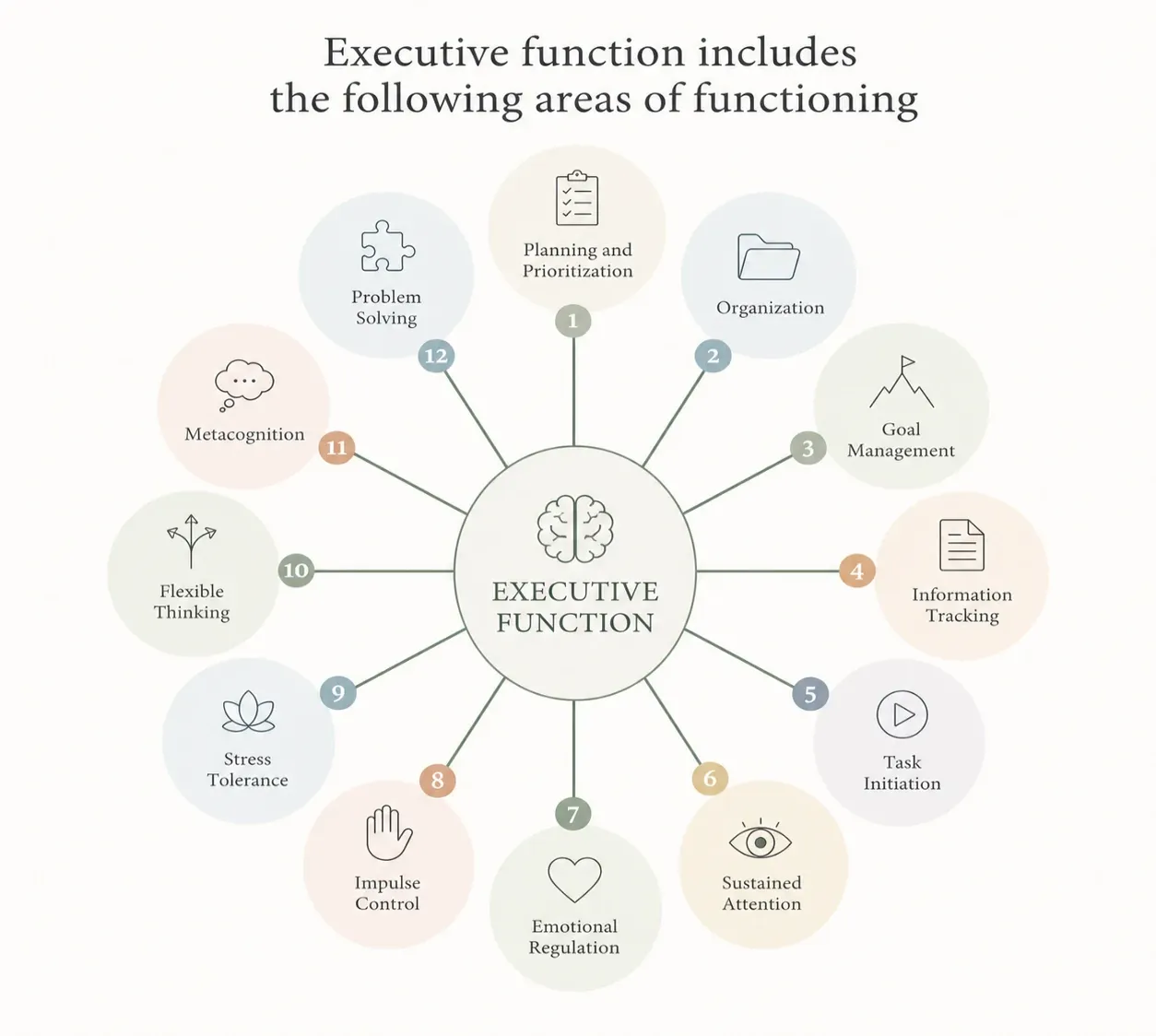
Think of executive function like the conductor of an orchestra.
Your attention, memory, planning, emotional regulation, and other areas of functioning are the different sections of the orchestra, each with an important role to play. The music is your goals, responsibilities, relationships, and priorities. Executive function – the conductor – coordinates each section, helping the instrumentalists come in at the right time, stay in balance, adapt to changes, and work together to create a cohesive performance.
As the music becomes more complex, the tempo changes, or different sections compete for attention, even a skilled orchestra can struggle to perform smoothly without strong coordination.

Executive function challenges are not a reflection of your capability. They often reflect a mismatch between the demands you’re facing and the systems you’ve had available to support you.
A Common Pattern: The Knowing-Doing Gap
People often assume:
“If I understand what needs to happen, I should be able to make it happen.”
But understanding what to do and consistently doing it rely on different skills.
Executive Function Challenges Are More Common Than You Think
Executive function is part of being human.
Executive function challenges are often associated with ADHD, but they are not exclusive to ADHD. Every one of us depends on these skills to navigate daily life. For some, executive function challenges have been present for as long as they can remember. For others, they emerge during seasons of stress, transition, burnout, or changing life demands.
Executive function can be impacted by many interacting factors, including:
- ✓ADHD and other forms of neurodivergence
- ✓Anxiety, depression, and chronic stress
- ✓Burnout and overwhelming life demands
- ✓Major transitions and changes in responsibility
- ✓Sleep and other health challenges
- ✓Learning differences
- ✓Parenting, caregiving, and competing priorities
- ✓Changes in school, work, relationships, or daily responsibilities
- ✓Environments that do not support the way someone naturally works
The question isn’t whether executive function challenges appear.
The question is:
How often do they appear?
How intensely do they impact daily life?
And how much support do you have to navigate them?
Sometimes learning about executive function feels less like discovering something new and more like finally having words for experiences you’ve carried for years.
Understanding changes the question.
Instead of asking...
What’s wrong with me?
You can begin asking...
What helps me thrive?
A Common Pattern: The Self-Criticism Cycle
The shift begins when you move from self-criticism to curiosity. Understanding how your brain works allows you to build systems that actually support the life you want.
The Executive Function Framework
The Executive Function Framework is built on three core pillars: Curiosity, Creativity, and Consistency. Each pillar guides you toward a deeper understanding of your brain, creating strategies that fit, and establishing systems that support lasting change.
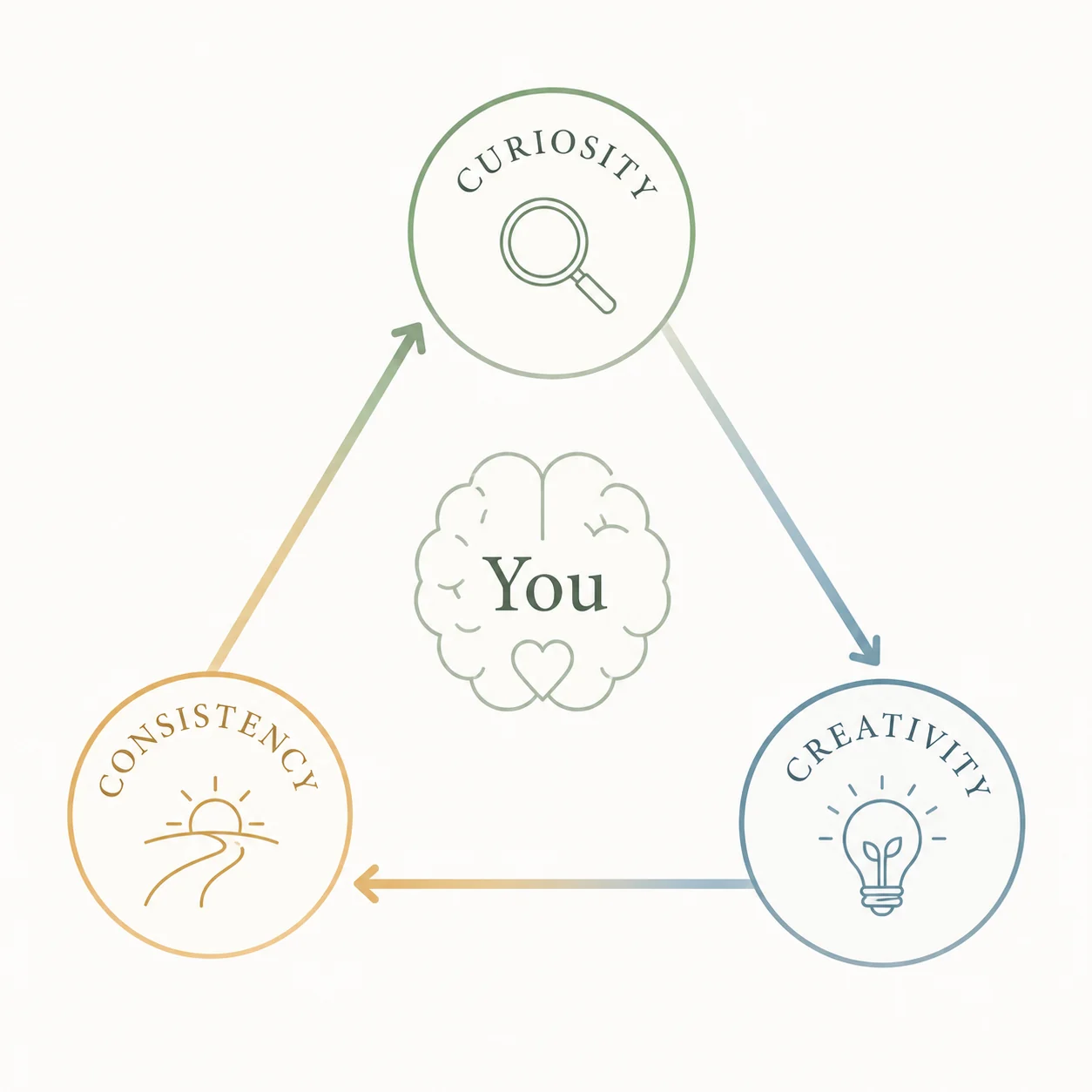
Get Curious
Understand your patterns.
Before we change anything, we get curious. Together, we uncover patterns, recognize strengths, and replace self-criticism with self-understanding.
Curiosity asks:
“What is happening here?”
Get Creative
Discover what works.
There is no one-size-fits-all approach. Together, we experiment with evidence-based strategies, systems, and supports that fit your brain, goals, and life.
Creativity asks:
“What else could work?”
Build Consistency
Create systems that last.
Consistency isn’t about perfection. It’s about building sustainable systems, accountability, and support that help you move forward – even when life gets hard.
Consistency asks:
“How do we make this sustainable?”
Executive function challenges are not a reflection of your capability. They often reflect a mismatch between the demands you’re facing and the systems you’ve had available to support you.
The Coaching Experience
Executive function coaching is more than learning new strategies. It is a collaborative process designed to meet you where you are and help you move forward with greater clarity, confidence, and support.
Change can often be difficult to create alone. Together, we explore your patterns, identify what is getting in the way, and discover strategies that align with the way your brain works and the life you want to build. Through reflection, experimentation, and ongoing adjustment, coaching helps you turn awareness into action and create systems you can return to – even when life becomes unpredictable.
Accountability is a foundational part of the Executive Function Framework coaching process; however, its purpose is not to create dependence on external support. Instead, it provides the structure and support needed to build awareness, self-trust, and independence over time.
Early in coaching, you may benefit from additional structure, encouragement, and accountability as we discover what works for you. Over time, the goal is to develop the systems, skills, and self-understanding needed to become your own advocate and strategist.
The goal isn’t perfection or eliminating every challenge. It’s building a life that’s more understandable, more intentional, and more sustainable.
A Common Pattern: The Strategy Shift
The strategy that works in one season of life may not work forever.
That doesn’t mean you’ve failed.
It may simply be time to evolve your systems for the season you’re in.
Services
WHO I SUPPORT
Teens & Young Adults
Executive function coaching supports teens and young adults in building the skills they need to manage increasing responsibilities without expecting them to simply “try harder.” Together, we may work on school demands, organization, time management, getting started, emotional regulation, navigating transitions, and developing systems that fit the way their brain works. The goal is not just getting through the next assignment or semester, but building greater confidence, self-awareness, and independence along the way.
School demands • Organization • Time management • Task initiation • Emotional regulation • Transitions • Independence
Adults
When you know what you need to do but consistently struggle to make it happen, everyday life can become surprisingly exhausting. Coaching offers a practical, individualized space to understand your executive function patterns, experiment with strategies, and create routines and systems that work in real life. We may focus on overwhelm, planning, emotional regulation, follow-through, routines, life transitions, or simply making everyday life feel more manageable and intentional.
Overwhelm • Planning & Prioritization • Organization • Routines • Task Initiation • Emotional Regulation • Follow-through • Life Transitions
Parents & Families
Executive function challenges rarely affect just one person. Coaching can empower families to better understand what is happening beneath recurring struggles, reduce friction around everyday expectations, and develop practical ways to support regulation, connection, and functioning at home. Together, we may work on home routines, family systems, co-regulation, effective scaffolding, communication, and gradually transferring responsibility as children and teens build greater independence.
Home routines • Family systems • Co-regulation • Scaffolding • Reducing friction • Supporting independence
WHAT TO EXPECT
Virtual coaching appointments are available worldwide. In-person services are available in the Colorado Springs, CO area, including in-home coaching when appropriate and by arrangement. Sessions are typically 50 minutes, held weekly or every other week, and are tailored to the needs, goals, and circumstances of each client.
After the initial intake session, most new clients begin with a 12-session foundational coaching package, providing time to understand patterns, identify meaningful goals, experiment with strategies, and build systems that become sustainable over time. Between-session coach support provides added accountability and an opportunity to troubleshoot challenges as new strategies are put into practice throughout the week. From there, clients who would like continued support can begin another package of coaching sessions or transition to individual sessions scheduled as needed.
The goal is not to keep you in coaching indefinitely. It is to provide meaningful support while you build the awareness, strategies, and confidence to move forward with greater independence.
Please reach out for current pricing, availability, and scheduling options.
Meet Your Executive Function Specialist
Hi, I’m Coach Adri.
I’ve always been fascinated by how people learn, adapt, and become who they are. Basically, I’ve spent most of my life asking some version of, “Why does this work for one person and absolutely not for another?”
For more than 25 years, my work has centered around learning, growth, and what happens when things don’t come easily. I’ve been a piano instructor, musician, homeschool educator, coach, and clinical therapist, which means I’ve had a front-row seat to a whole lot of learning, frustration, problem-solving, confidence-building, and human complexity.
Looking back, executive function has been hiding in plain sight through all of it. Teaching students to practice effectively, navigate frustration, and master complex skills? Executive function. Studying how individuals and families adapt, relate, and change? Turns out, there’s quite a bit of overlap. Executive function coaching became the place where a lot of seemingly different pieces of my career finally made sense together.
Outside of coaching, I’m a parent of six busy, creative, wonderfully different kids. Executive function is basically a daily field study in our house. When I’m not coaching or managing the logistics of a small civilization, you can find me weightlifting, hiking, traveling, playing piano, cooking, practicing yoga, finding an excuse to be outside, or enjoying a movie with my family.
Credentials & Training
M.S., Marriage and Family Therapy
Marriage and Family Therapist Candidate (MFTC), Colorado
B.M., Piano Performance
25+ years teaching and coaching learners across the lifespan